![china-omp-serviced-office-image-202603-cl.jpg]()
A Chinese company's business licence states the company's name and its address. Founders who have set up companies in other markets may expect that address to belong to an accountant or a mail service. In China, it has to belong to an office.
So the answer is yes: you need a physical office to register a company in China, and an address on its own is not enough. What varies is the kind of office and how a company arranges it.
In short:
- The registered address must be a physical office approved for commercial use, which a mailbox or mail-handling address is not
- A virtual office address is a presence for marketing and correspondence only and cannot be used to register a company
- The office can be leased and fitted out by the company, or taken as a private serviced office that is ready to use
The Address on the Licence and the Addresses Clients See
A company working in China can end up with several addresses. The registered address is the one on the business licence. Then there is the address on the website, business cards and letterhead, and the address where post and couriers arrive, which may or may not be the same place.
Address services, from mail handling to virtual offices, are built for those last two. The registered address is a different matter: it needs an office behind it, which a mail-handling address does not have.
Keeping the two kinds of address apart avoids an easy mistake for an overseas company: thinking the local address already printed on its proposals and business cards can also go on the registration application.
Physical Office and Virtual Office Address Compared
Both give a company an address in an office building, which makes them easy to confuse.
|
|
Physical office approved for commercial use
|
Virtual office address
|
|
Can it be the registered address?
|
Yes, where it meets the local requirements
|
No
|
|
What it is for
|
The company's registered address, and a place to work and meet clients
|
Marketing materials, correspondence, and mail and parcel handling
|
|
What the company has
|
A private office of its own
|
An address, usually with a local phone number answered in the company's name and rooms to book when needed
|
|
When it fits
|
When a company registers an entity, or its team starts working in China
|
While a company tests the market or serves Chinese clients from overseas
|
When a company is registered in China, its registered address must be a physical office approved for commercial use, and a virtual office address does not satisfy that. A virtual office does a different job, giving a company a local address and point of contact while its people work elsewhere.
A conventional lease lets a company choose its own building and district. The company then fits out and furnishes the space and arranges phone lines, internet and reception before the team moves in. That route can suit a company that expects to need room for a sizeable team from the start.
Leasing an Office or Taking a Private Serviced Office
Which route suits a company depends on practical questions: how many people will work in the office in the first year, whether clients will visit, and who will answer the phone and receive post when the team is out. The registration itself is work for a qualified lawyer, accountant or corporate service adviser, and it helps to involve one before signing for an office.
Leasing and Fitting Out Your Own Space
A conventional lease lets a company choose its own building and district. The company then fits out and furnishes the space and arranges phone lines, internet and reception before the team moves in. That route can suit a company that expects to need room for a sizeable team from the start.
A Private Serviced Office in a Commercial Building
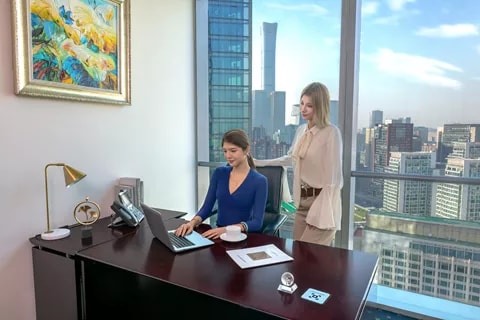
A private serviced office is an office in a commercial building that one company uses on its own, with furniture, connectivity and reception already in place. It can suit a company starting with one or two people in China, who need calls answered and post received while they are out seeing clients. Space can be added in steps as the team grows. Some serviced office providers also arrange private offices specifically for companies registering in China.
Servcorp's Company Registration service is one example. It includes a private one-person office with its own suite number in one of four Company Registration locations in Beijing and Shanghai: Fortune Financial Centre and China Central Place in Beijing, and One Museum Place and Citigroup Tower in Shanghai. The service also includes a local phone number answered in the company's name by a bilingual receptionist on site, mail and courier handling, access to Servcorp's coworking spaces and a bilingual support team.
Final Thoughts
An address on its own, however good the building, cannot register a company in China. A virtual office keeps its place as the address on marketing materials and correspondence, and as somewhere for post to arrive.
The choice that remains is between a space that the company fits out itself and a private serviced office that is ready to use. The wider commercial questions to settle before setting up a company, from demand to location, are worth working through alongside it.
Frequently Asked Questions: